So you want to start eating healthier. Easier said than done! Where do you begin? And how can you start …

Living Healthier:
how to get started?
We’re all getting older, but how can we make sure we do it healthily and energetically? Temptations are everywhere: chocolate, a glass of wine, the couch. Sometimes, living a healthy life seems impossible. But guess what? It’s not. Start small, with smart choices that give you energy and balance. Before you know it, you’re living more better days.
Living healthier isn’t about perfection—it’s about progress. Step by step, without pressure. We’ll show you the key factors that contribute to a healthy lifestyle and how to seamlessly integrate them into your daily life without stress.
What is a healthy lifestyle?
Lifestyle refers to how you live every day. All those daily choices, big and small, impact your body and mind. A healthy lifestyle ensures that you stay physically and mentally in top shape for as long as possible.
Your lifestyle is made up of various elements, also known as lifestyle factors. Nutrition and exercise are the most well-known, but there’s more. These are the six most important lifestyle factors you can influence:
- Nutrition
- Exercise
- Sleep
- Relaxation
- Substances
- Social connections
Living healthily: Why would you want to?
Living healthily might seem like a challenge. Your schedule is already full, and now you’re supposed to work on six aspects of your lifestyle? Don’t worry: you don’t have to do everything at once. Think of it as a gift to yourself and your loved ones. The benefits often show quickly, but the real success is in the long term. Want to grow old fit and vital? It starts with the choices you make now. (1,2)
With a healthy lifestyle, you reduce the risk of diseases like cancer, diabetes, Alzheimer’s, and cardiovascular issues. Prevention is always better than cure. (3) Did you know that a healthy lifestyle can add an average of 10 years of disease-free living? (1) That’s 10 extra years to enjoy friends, family, hobbies, and everything that makes you happy. Who wouldn’t want that?
Tips for a Healthy Lifestyle
A healthy lifestyle is a combination of big and small choices. You don’t have to change everything at once; tackling a new element step by step often works better. Once you start, you’ll find that making healthy choices becomes increasingly easier.Below are tips, divided over the 6 main lifestyle factors, to help you live a bit healthier every day.
1. Nutrition
A healthy diet is about what you do eat and what you might want to avoid. Essential nutrients like vitamins and minerals are crucial to keep your body in top condition. At the same time, much of the food we consume daily contains elements our body doesn’t need and can even harm us in the long run. And whether it’s healthy or unhealthy: consistently overeating simply leads to overweight.
Tip: Prevent Overweight
Overweight and obesity are major predictors of a lower life expectancy and quality. (1) But there’s good news: 70% of your BMI is determined by what you eat. By calculating your calorie needs, you can discover how many calories you need daily, tailored to your goal: losing weight, gaining (muscle mass), or maintaining weight.
Read more: What is a healthy body fat percentage?
Finding it difficult to stay within your recommended calorie intake? Try replacing 1-2 meals a day with a high-quality meal shake.
Tip: Eat More Plant-Based Foods
Vegetables, fruits, legumes, nuts, and seeds: plant-based foods are packed with vitamins, minerals, antioxidants, and other bioactive substances that keep your body healthy.
Struggling to reach those 250 grams of vegetables and 2 pieces of fruit per day? Time to change your approach. Start with a good green juice or sneak extra vegetables and fruits into your snacks and recipes. Need inspiration? Check out our healthy recipes. No time? Supplements can give you that extra boost.
Tip: Minimize Unhealthy Foods
We all know it: not everything we eat and drink is good for us. Some choices even have a negative impact on your health. Choose what truly contributes to a fit and healthy life.
In a healthy lifestyle, avoid products with:
- Sugar: Not only found in candy and soft drinks but also in many ready-made products.
- Saturated fats: Present in animal products, cookies, pastries, and snacks.
- Trans fats: Nowadays mainly found in meat and dairy.
- Acrylamide: A toxic substance that forms when heating starchy products, such as fried foods, chips, and breakfast cereals.
Tip: Stay Hydrated
Your body consists of 50-70% water, so drinking enough is essential. Aim for 1.5 to 2 liters of fluids per day.
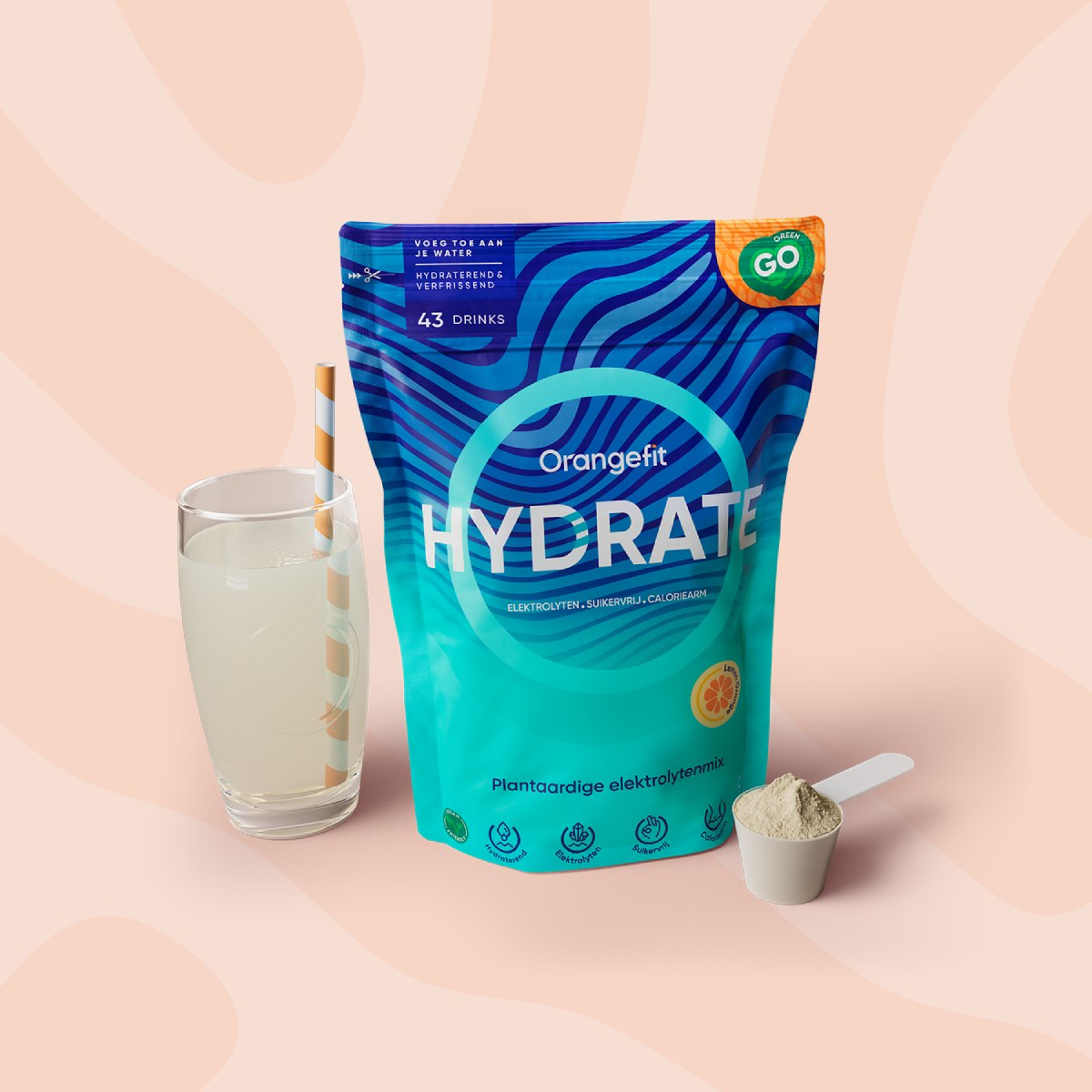
For optimal hydration, it’s best to choose water, tea, coffee, or other sugar-free drinks. Do you exercise a lot? Then you lose a lot of fluids. Try Orangefit® Hydrate: a sugar-free, low-calorie electrolyte powder with a balanced mix of electrolytes. Just mix with water, and you’re back on track.

Living Healthier: How to get started
Living healthier isn’t about perfection—it’s about progress. Step by step, without pressure. We’ll show you the key factors that contribute to a healthy lifestyle and how to seamlessly integrate them into your daily life without stress.
What is a healthy lifestyle?
Lifestyle refers to how you live every day. All those daily choices, big and small, impact your body and mind. A healthy lifestyle ensures that you stay physically and mentally in top shape for as long as possible.
Your lifestyle is made up of various elements, also known as lifestyle factors. Nutrition and exercise are the most well-known, but there’s more. These are the six most important lifestyle factors you can influence:
- Nutrition
- Exercise
- Sleep
- Relaxation
- Substances
- Social connections
Living healthily: Why would you want to?
Living healthily might seem like a challenge. Your schedule is already full, and now you’re supposed to work on six aspects of your lifestyle? Don’t worry: you don’t have to do everything at once. Think of it as a gift to yourself and your loved ones. The benefits often show quickly, but the real success is in the long term. Want to grow old fit and vital? It starts with the choices you make now. (1,2)
With a healthy lifestyle, you reduce the risk of diseases like cancer, diabetes, Alzheimer’s, and cardiovascular issues. Prevention is always better than cure. (3) Did you know that a healthy lifestyle can add an average of 10 years of disease-free living? (1) That’s 10 extra years to enjoy friends, family, hobbies, and everything that makes you happy. Who wouldn’t want that?
Tips for a Healthy Lifestyle
A healthy lifestyle is a combination of big and small choices. You don’t have to change everything at once; tackling a new element step by step often works better. Once you start, you’ll find that making healthy choices becomes increasingly easier.Below are tips, divided over the 6 main lifestyle factors, to help you live a bit healthier every day.
1. Nutrition
A healthy diet is about what you do eat and what you might want to avoid. Essential nutrients like vitamins and minerals are crucial to keep your body in top condition. At the same time, much of the food we consume daily contains elements our body doesn’t need and can even harm us in the long run. And whether it’s healthy or unhealthy: consistently overeating simply leads to overweight.
Tip: Prevent Overweight
Overweight and obesity are major predictors of a lower life expectancy and quality. (1) But there’s good news: 70% of your BMI is determined by what you eat. By calculating your calorie needs, you can discover how many calories you need daily, tailored to your goal: losing weight, gaining (muscle mass), or maintaining weight.
Read more: What is a healthy body fat percentage?
Finding it difficult to stay within your recommended calorie intake? Try replacing 1-2 meals a day with a high-quality meal shake.
Tip: Eat More Plant-Based Foods
Vegetables, fruits, legumes, nuts, and seeds: plant-based foods are packed with vitamins, minerals, antioxidants, and other bioactive substances that keep your body healthy.
Struggling to reach those 250 grams of vegetables and 2 pieces of fruit per day? Time to change your approach. Start with a good green juice or sneak extra vegetables and fruits into your snacks and recipes. Need inspiration? Check out our healthy recipes. No time? Supplements can give you that extra boost.
Tip: Minimize Unhealthy Foods
We all know it: not everything we eat and drink is good for us. Some choices even have a negative impact on your health. Choose what truly contributes to a fit and healthy life.
In a healthy lifestyle, avoid products with:
- Sugar: Not only found in candy and soft drinks but also in many ready-made products.
- Saturated fats: Present in animal products, cookies, pastries, and snacks.
- Trans fats: Nowadays mainly found in meat and dairy.
- Acrylamide: A toxic substance that forms when heating starchy products, such as fried foods, chips, and breakfast cereals.
Tip: Stay Hydrated
Your body consists of 50-70% water, so drinking enough is essential. Aim for 1.5 to 2 liters of fluids per day.
For optimal hydration, it’s best to choose water, tea, coffee, or other sugar-free drinks. Do you exercise a lot? Then you lose a lot of fluids. Try Orangefit® Hydrate: a sugar-free, low-calorie electrolyte powder with a balanced mix of electrolytes. Just mix with water, and you’re back on track.

FITBLOGS
More about living healthier
How many proteins do you need daily?
So you want to start eating healthier. Easier said than done! Where do you begin? And how can you start …
What is a healthy body fat percentage?
So you want to start eating healthier. Easier said than done! Where do you begin? And how can you start …
Calorie needs calculation? Calculating required calories
So you want to start eating healthier. Easier said than done! Where do you begin? And how can you start …
Source:
(1) De Vries, J. D., Van Hooff, M. L., Guerts, S. A., & Kompier, M. A. (2017). Exercise to reduce work-related fatigue among employees: a randomized controlled trial. Scandinavian Journal of Work Environment & Health, 43(4), 337–349.
(2) Herold, F., Törpel, A., Schega, L., & Müller, N. G. (2019). Functional and/or structural brain changes in response to resistance exercises and resistance training lead to cognitive improvements – a systematic review. European Review of Aging and Physical Activity, 16(1).
(3) O’Bryan, S. J., Giuliano, C., Woessner, M. N., Vogrin, S., Smith, C., Duque, G., & Levinger, I. (2022). Progressive resistance training for concomitant increases in muscle strength and bone mineral density in older Adults: A Systematic Review and Meta-Analysis. Sports Medicine, 52(8), 1939–1960.
(4) Shailendra, P., Baldock, K. L., Li, L. K., Bennie, J. A., & Boyle, T. (2022). Resistance Training and Mortality Risk: A Systematic Review and Meta-Analysis. American Journal of Preventive Medicine, 63(2), 277–285.
(5) Børsheim, E., & Bahr, R. (2003). Effect of exercise intensity, duration and mode on Post-Exercise oxygen consumption. Sports Medicine, 33(14), 1037–1060.
(6) Wewege, M. A., Desai, I., Honey, C., Coorie, B., Jones, M. D., Clifford, B. K., Leake, H. B., & Hagstrom, A. D. (2021). The Effect of resistance training in healthy Adults on body fat percentage, fat mass and visceral Fat: A Systematic Review and Meta-Analysis. Sports Medicine, 52(2), 287–300.